
Conference poster · text version
Balancing Harm
Culturally Informed Cannabis Substitution to Mitigate Alcohol Industry Impact
Presented at the 2024 PHABC Conference - “Commercial Determinants of Health: Moving from Harmful to Healthy.”
The poster
Background
While Managed Alcohol Programs (MAPs) provide harm reduction for severe alcohol dependence, complementary approaches are needed. Cannabis substitution has emerged as a potential intervention within MAPs to address complex needs of participants experiencing alcohol use disorder (AUD).
Introduction
This is an evaluation of medical cannabis intervention in a map setting. With 40 participants (78% first nations), the program integrates cultural knowledge with harm reduction approaches. Using ai-supported monitoring, we examine:
- Impact of stressors on substance use
- Role of cannabis in managing alcohol consumption
- Changes in health outcomes
- Harm reduction potential
Objective & Methodology
We seek to assess how medical cannabis helps participants manage their alcohol use and cope with stressors.
Data Collection
- Daily tablet check-ins
- Weekly qualitative interviews
- Quantitative health metrics
- AI-supported monitoring
Study Design
- 6-month mixed-methods evaluation
- 40 MAP participants (78% First Nations)
- Integration of cultural knowledge
- Digital literacy promotion
Findings
Our evaluation examines the impact of stressors and medical cannabis intervention on alcohol consumption in a MAP setting. Through daily monitoring and AI-supported data collection, we tracked substance use patterns, health outcomes, and treatment engagement.
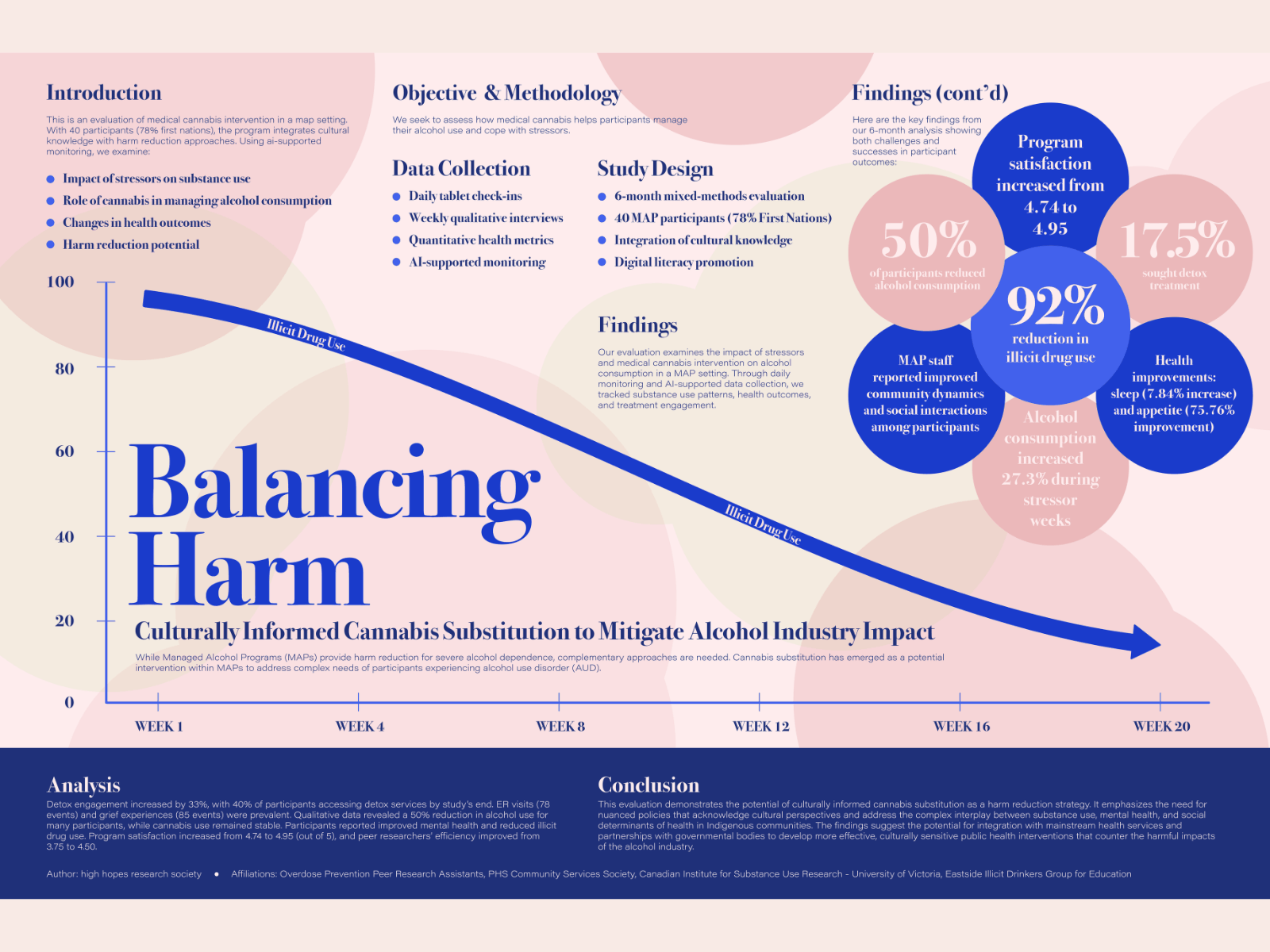
Here are the key findings from our 6-month analysis showing both challenges and successes in participant outcomes:
- 50% of participants reduced alcohol consumption
- Program satisfaction increased from 4.74 to 4.95
- 17.5% sought detox treatment
- 92% reduction in illicit drug use
- MAP staff reported improved community dynamics and social interactions among participants
- Health improvements: sleep (7.84% increase) and appetite (75.76% improvement)
- Alcohol consumption increased 27.3% during stressor weeks
Chart: Illicit drug use
The poster’s background is a line chart. Its vertical scale runs from 0 to 100, with no unit given. Its horizontal axis marks Week 1, Week 4, Week 8, Week 12, Week 16 and Week 20.
A single arrow labelled “Illicit Drug Use” starts near the top of the scale at Week 1 and curves down to near the bottom of the scale at Week 20.
Analysis
Detox engagement increased by 33%, with 40% of participants accessing detox services by study’s end. ER visits (78 events) and grief experiences (85 events) were prevalent. Qualitative data revealed a 50% reduction in alcohol use for many participants, while cannabis use remained stable. Participants reported improved mental health and reduced illicit drug use. Program satisfaction increased from 4.74 to 4.95 (out of 5), and peer researchers’ efficiency improved from 3.75 to 4.50.
Conclusion
This evaluation demonstrates the potential of culturally informed cannabis substitution as a harm reduction strategy. It emphasizes the need for nuanced policies that acknowledge cultural perspectives and address the complex interplay between substance use, mental health, and social determinants of health in Indigenous communities. The findings suggest the potential for integration with mainstream health services and partnerships with governmental bodies to develop more effective, culturally sensitive public health interventions that counter the harmful impacts of the alcohol industry.
Author and affiliations
Author: high hopes research society
Affiliations: Overdose Prevention Peer Research Assistants, PHS Community Services Society, Canadian Institute for Substance Use Research - University of Victoria, Eastside Illicit Drinkers Group for Education