
Conference poster · text version
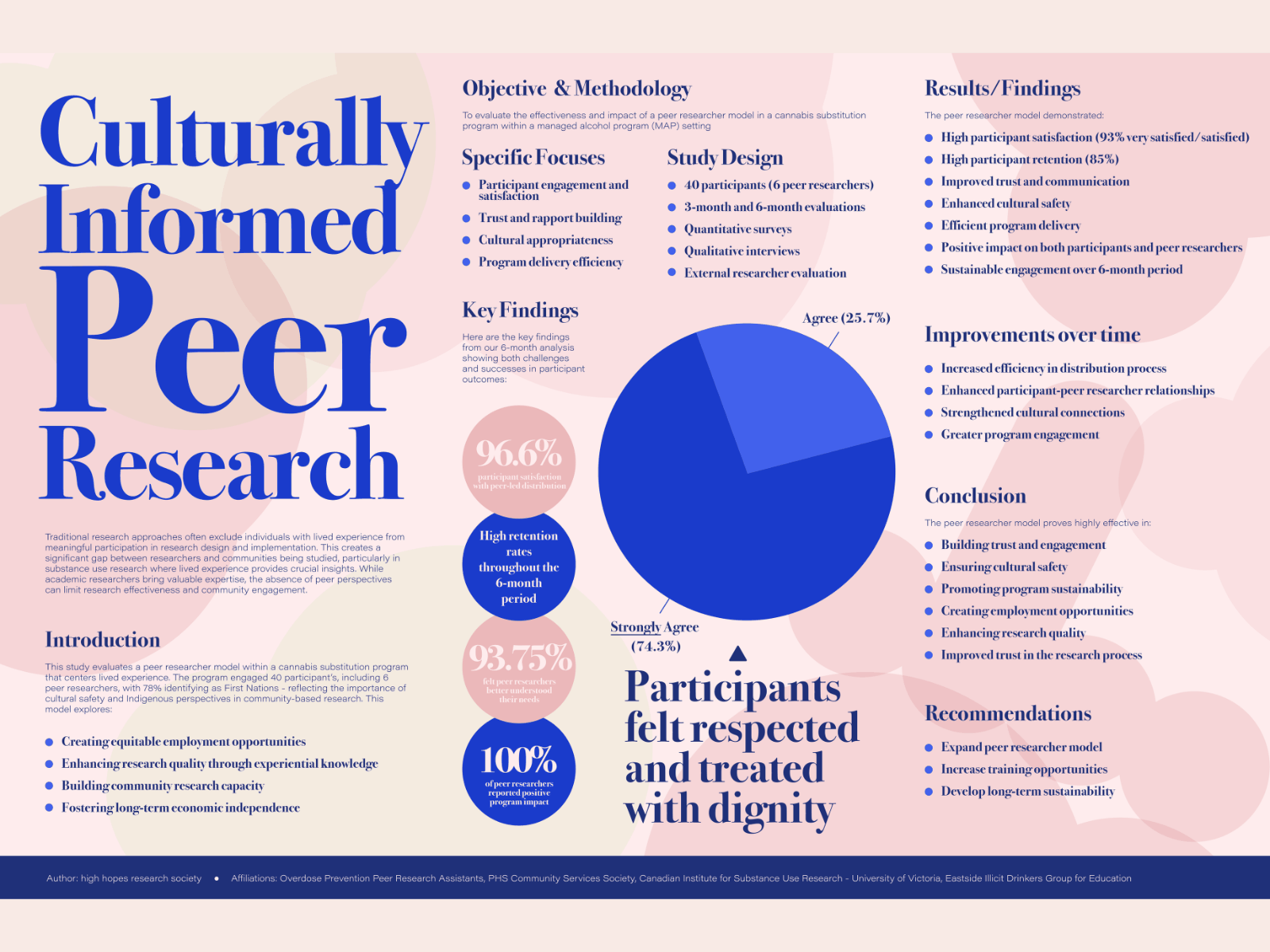
Culturally Informed Peer Research
Peer Researchers as Partners in Cannabis Substitution Research
Presented at the 2024 PHABC Conference - “Commercial Determinants of Health: Moving from Harmful to Healthy.”
The poster
Background
Traditional research approaches often exclude individuals with lived experience from meaningful participation in research design and implementation. This creates a significant gap between researchers and communities being studied, particularly in substance use research where lived experience provides crucial insights. While academic researchers bring valuable expertise, the absence of peer perspectives can limit research effectiveness and community engagement.
Introduction
This study evaluates a peer researcher model within a cannabis substitution program that centers lived experience. The program engaged 40 participant’s, including 6 peer researchers, with 78% identifying as First Nations - reflecting the importance of cultural safety and Indigenous perspectives in community-based research. This model explores:
- Creating equitable employment opportunities
- Enhancing research quality through experiential knowledge
- Building community research capacity
- Fostering long-term economic independence
Objective & Methodology
To evaluate the effectiveness and impact of a peer researcher model in a cannabis substitution program within a managed alcohol program (MAP) setting
Specific Focuses
- Participant engagement and satisfaction
- Trust and rapport building
- Cultural appropriateness
- Program delivery efficiency
Study Design
- 40 participants (6 peer researchers)
- 3-month and 6-month evaluations
- Quantitative surveys
- Qualitative interviews
- External researcher evaluation
Key Findings
Here are the key findings from our 6-month analysis showing both challenges and successes in participant outcomes:
- 96.6% participant satisfaction with peer-led distribution
- High retention rates throughout the 6-month period
- 93.75% felt peer researchers better understood their needs
- 100% of peer researchers reported positive program impact
Participants felt respected and treated with dignity
A pie chart shows the responses: Strongly Agree (74.3%) and Agree (25.7%).
Results/Findings
The peer researcher model demonstrated:
- High participant satisfaction (93% very satisfied/satisfied)
- High participant retention (85%)
- Improved trust and communication
- Enhanced cultural safety
- Efficient program delivery
- Positive impact on both participants and peer researchers
- Sustainable engagement over 6-month period
Improvements over time
- Increased efficiency in distribution process
- Enhanced participant-peer researcher relationships
- Strengthened cultural connections
- Greater program engagement
Conclusion
The peer researcher model proves highly effective in:
- Building trust and engagement
- Ensuring cultural safety
- Promoting program sustainability
- Creating employment opportunities
- Enhancing research quality
- Improved trust in the research process
Recommendations
- Expand peer researcher model
- Increase training opportunities
- Develop long-term sustainability
Author and affiliations
Author: high hopes research society
Affiliations: Overdose Prevention Peer Research Assistants, PHS Community Services Society, Canadian Institute for Substance Use Research - University of Victoria, Eastside Illicit Drinkers Group for Education